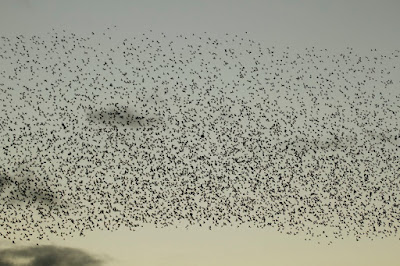
31st: 3 Lapwings over Ensay Burn and Treshnish House, 1 Sparrowhawk over Treshnish wood and the Golden Eagle pair calling over Ensay and Treshnish wood. From Ensay I could see them hunting low down over the meadows below Ensay farmhouse, an area we can't see from our house, so it was a new experience. That field is a good field to see Mountain Hares and presumably that is what they were after.


30th: 1 Black-headed Gull on Calgary beach (first here since the autumn) and 1 Dipper by stone-bridge over Ensay Burn on Ensay-Reudle road.
29th: Using GeoGebra software I have been playing around with TIARG statistic using linear regression which must be similar to what the TIARG reports use when citing a decline.
30th: 1 Black-headed Gull on Calgary beach (first here since the autumn) and 1 Dipper by stone-bridge over Ensay Burn on Ensay-Reudle road.
29th: Using GeoGebra software I have been playing around with TIARG statistic using linear regression which must be similar to what the TIARG reports use when citing a decline.
Fulmar is cited as in a decline of -3.5% per annum since 1994 in TIARG. I am not sure I have quite got the hang of this because a -3.5% decline should mean extinction within 30 years (from 1994 i.e. by about 2024) where as my graph shows extinction in about 2045.
I am in no way doubting TIARGs reports just playing around with graph making software and statistics. I presume they chose to work from 1994 base line for good reasons,
This is the graph for Fulmar from 1994

It is interesting that even though this graph from 1993 (below) has the start and end point identical the linear regression is only slightly different from 1994 (above).

and from 1971

This the post 1993 graph for Kittiwake

and post 1971.

This is the post 1993 graph for Razorbill

and post 1971.

Obviously the scale is diffrent for the graphs covering the longer period.
I am not suggesting that these species are increasing only that there must be other factors at work, possibly improved counting methods or insufficient data for the pre 1993 years.
27th: 6 Whooper Swans at Loch Peallach, Mishnish.

Went to look for a wheatear reported at Glengorm on the 23rd. There was a possibility that it was a Desert Wheatear, which is very rare in Scotland with only 17 records up to 2007 (13 in autumn and 1 in June). From what I can gather Desert Wheatear is just as likely in the winter in Scotland as Northern Wheatear (there is one Desert Wheatear right now in Aberdeenshire). Up until 2007 there were 3 winter (Dec - Feb) records of Desert Wheatear compared to 4 of Northern Wheatear.
I checked The Birds of Scotland (SOC) and none of the other rare wheatear species have been recorded in winter and they are also much rarer even than Desert Wheatear.
This is a Desert Wheatear I took near Pune, India in 2005 (the female has no black on the head and is much more similar to a female of our Northern Wheatear)

No one seemed to be going to check it out (it only became public yesterday) so thought I should have a look. As it turned out when I was nearly there I met Arthur Brown who had been but hadn't seen it.
I couldn't find it either but there were 5 Redwing, several Rock Pipits and 2-3 Stonechats.

Whilst photographing the pipits a ring-tailed Hen Harrier landed only 20m away from me but as I raised the camera it flew off. An adult White-tailed Eagle flew over, I can see it had tags but from below I can't see the colour.

This Rock Pipit could be of the Scandinavian subspecies. It might be good to go back in the spring when the plumage is obvious.

3 Otters at Glengorm made the trip worthwhile.


25th: I stumbled on some old data in the TIARG reports which I'd missed previously. It has enabled me to make graphs going back to 1971. I concentrated on the 3 species which seem to be in decline judging by the recent TIARG reports. Red lines are from the years with irregular record and blue is from the years with annual recording.
Razorbill

Kittiwake

Fulmar

I am not sure why the TIARG reports use 1994 as a base-line when they have annual data from the previous year. For Fulmar 1994 was an exceptionally good year and if the previous year is taken as a baseline there has been no change overall since then (in fact there was one more pair in 2012).
The means are more significant. For Fulmar the mean for all 42 years since records began is 449 nests and so the 2012 count of 464 was +3.3% above the mean whereas analysing only the 20 years since 1993, the mean is 490 and so 2012 was -5.5% below the mean.This is because of the highs of 1994-2005 which could be part of a cycle, the highest year in 1971 was apparently followed by several low years (or to be more precise no recorded high years).
Razorbill numbers are very low now compared to the high counts within the last 20 years but fairly normal compared with the pre 1993 figures. Even so, 2009 and 2010 were the second and third lowest years on records and hopefully the part recovery of the last 2 years will continue.
Kittiwake numbers are down in the long and medium term graphs and the status of this species is, to me, the most worrying.
The years 1994-2005 had some exceptionally good years for Fulmar, Razorbill and Kittiwake so perhaps the question should not be so much, why the declines but why the highs? It remains to be seen really what these trends mean for the future of these 3 species and it may take another 10 years before the picture becomes more clear.
Eagle eyes may have noticed some minor difference between my graphs and TIARG's graphs posted on 24th. That is because their graphs are for Lunga only and mine are for the total of Lunga and Sgeir a' Chaisteil. This graph for Fulmar from the last 10 years shows how they are mostly parallel but in 2005 the colony at Sgeir a' Chaisteil did well. The red line is both colonies, blue is Lunga and yellow is Sgeir a' Chaisteil.

24th: The Treshnish Isles Auk Ringing Group Report has come out early this year. Click here to read in full. The results are very interesting.
Here are the graphs of 8 species.


All of these species have done better this year than last year except Herring Gull. Obviously the increases in Kittiwake and Fulmar numbers are only slight but give a ray of hope for future recovery. The species that had the best year in 2012 was the Puffin which had a 89% increase on 2011 with 3,037 estimated occupied burrows (EOB). Actually I think the graph might be not quite right as the data I have gives 2012 as the second best count ever (2006 being the only year with a slightly higher count with 3,095 EOBs). The discrepancy could be that the graph gives the count on Lunga whereas the text gives count for Lunga & Sgeir a´ Chaisteil.
Either way, certainly no cause for alarm. Regarding the blame for an imaginary Puffin 'decline' being blamed on White-tailed Eagle I had an idea to check the old TIARG reports for White-tailed Eagle sightings. TIARG are on the Treshnish Isles for one week every year and for 2 weeks in 2011 and they have NEVER even seen a White-tailed Eagle there never mind witnessed predation. I know White-tailed Eagle do go out to the Treshnish Isles sometimes, as I have seen them myself and there is bound to be some level of predation but it certainly doesn't appear to be a common occurrence.
23rd: Spent over 4 hours looking for the Chough today but with no luck. I did see a dozen Meadow Pipits and a Golden Eagle.

22nd: at least 5 Purple Sandpipers & at least 5 Turnstones at Lainne Sgeir, Calgary & 1 Redshank on beach, 1 male Hen Harrier nr Ensay Burn mouth and Fieldfare heard below Ensay farmhouse.
20th: Male Hen Harrier above Treshnish wood. I only got a brief glimpse but I think I it may have been an immature.
19th: Pair of yellow tagged C & E adult White-tailed Eagles at Langamull. Yellow C is in the tall conifer behind Langamull, with Ardhamurchan behind.

Ring-tailed Hen Harrier below Bennan and at least 5 Fieldfares below Ensay farmhouse.

18th: Spent 2 hours looking for the Chough. I couldn't find it but I saw more feeding holes at one of its favoured spots.

I took photos of a distant bird which I was hoping was the Chough but it turned out to be Rook, which is scarce north of Ulva ferry. I haven't seen one since March.
Also saw a pair of Golden Eagles.
No sign of the washed up Minke Whale near Lainne Sgier. I haven't looked for ages so don't know how long it has been gone. Also notice one of my jaw bones has been pinched (the atlas vertebra went long ago). I should have hidden them better.
Very disappointing the aurora alert amounted to very little, just a diffuse glow in the north-east at about 9pm.
16th: Juliet Vines saw the Chough at the usual location. It was seen mobbing a Golden Eagle!
15th: 1 Mountain Hare at Treshnish lochan.
14th: I was woken up by the call of Golden Eagles. The wind was from the north. Unfortunately they didn't stay for long so I wonder if they made a kill.

A flock of about 8 finches flew over which I think must have been Bullfinches.
10th: 3 Redwings and 1 Skylark near Treshnish Old Schoolhouse, 1 Woodcock flying around Mornish Schoolhouse at dusk.
Cormorant sunbathing at Langamull.

1 Otter at Langamull and 1 Mountain Hare in our garden and another on Langamull machair. This is typical of the winter plumage in northwest Mull (white rear legs, belly, backs of ears and backs of front legs). A a couple of years ago I did see one with more white than this at Allt Crossapol near Langamull.

9th: At least 5 Purple Sandpipers and 4 Turnstones at Lainne Sgeir, Calgary. An adult yellow tagged White-tailed Eagle above the hills near Port Ensay flew north across Calgary bay. This is most probably one of the Langamull pair.
8th: The Chough is still present at the same location although slightly to the east of where it was seen on the 31st of Dec.


It likes to look for invertebrates feed on the short turf (as shown on photo from 31st of Dec) but also the rock edges

and these small earth ledges.

Also female Golden Eagle,

an intruding juvenile Golden Eagle and a glimpse of what must have been a White-tailed Eagle.
At least 2 almost certainly 3 Purple Sandpipers at Lainne Sgeir, Calgary (my first of the winter but only because I haven't been checking Lainne Sgeir often enough at high-tide).
Ravens are very difficult to photograph because of they are so black. This was one of my best.


7th: male Hen Harrier behind Treshnish Old Schoolhouse and at dusk a Mountain Hare (no winter colouration) on our back lawn
6th: 1 Golden Eagle flew from Cnoc an t-Sidhein over Black Park and Skoma fields. Golden Eagles are more likely to appear on the northern Treshnish coast with a northerly wind but it is not a hard and fast rule and today's south-westerly proved the exception.
Male Hen Harrier over Skoma field. At dusk there was a Mountain Hare between Treshnish House and the Old Schoolhouse which had an overall pale grey colour with white back legs, tail and back of the ears and a minute later there was another in the garden of the Old Schoolhouse but that one was not pale and had no obvious white. John Clare who has written a booklet on Mull Mountain Hares thinks that both the Irish and Scottish subspecies were introduced on Mull based as far as I can gather on the fact that some of the Mull hares turn partly white in the winter. I would love to be sure of this. If both subspecies were brought to Mull then presumably they have hybridised and the genes of both must be present in all Mull hares. If Irish Mountain Hares never show any white in winter, it follows that the partly white hares I see low down at the coast must be either Scottish Mountain Hares or hybrids and proves that altitude is no barrier to hybridisation.
5th: 1 male Hen Harrier at Haunn.
4th: 1 Woodcock at dusk around Treshnish House.
1st: A nice welcome to the new year by the Golden Eagles. The female was calling vigorously and display diving outside our window.

With Rubha nan Oirean in background

No doubt the male was close by but we decided to go to Langamull. On the way back there were 3 different Golden Eagles above the cliffs above Lainne Sgeir, Calgary, one of which was a juvenile. Five goldies within a couple of hours!
At Langamull there were the usual pair of White-tailed Eagles, 12 Meadow Pipits and a flock of at least 6 Long-tailed Tits at Allt Crossapol.
I am in no way doubting TIARGs reports just playing around with graph making software and statistics. I presume they chose to work from 1994 base line for good reasons,
This is the graph for Fulmar from 1994
It is interesting that even though this graph from 1993 (below) has the start and end point identical the linear regression is only slightly different from 1994 (above).
and from 1971
This the post 1993 graph for Kittiwake
and post 1971.
This is the post 1993 graph for Razorbill
and post 1971.
Obviously the scale is diffrent for the graphs covering the longer period.
I am not suggesting that these species are increasing only that there must be other factors at work, possibly improved counting methods or insufficient data for the pre 1993 years.
27th: 6 Whooper Swans at Loch Peallach, Mishnish.
Went to look for a wheatear reported at Glengorm on the 23rd. There was a possibility that it was a Desert Wheatear, which is very rare in Scotland with only 17 records up to 2007 (13 in autumn and 1 in June). From what I can gather Desert Wheatear is just as likely in the winter in Scotland as Northern Wheatear (there is one Desert Wheatear right now in Aberdeenshire). Up until 2007 there were 3 winter (Dec - Feb) records of Desert Wheatear compared to 4 of Northern Wheatear.
I checked The Birds of Scotland (SOC) and none of the other rare wheatear species have been recorded in winter and they are also much rarer even than Desert Wheatear.
This is a Desert Wheatear I took near Pune, India in 2005 (the female has no black on the head and is much more similar to a female of our Northern Wheatear)
No one seemed to be going to check it out (it only became public yesterday) so thought I should have a look. As it turned out when I was nearly there I met Arthur Brown who had been but hadn't seen it.
I couldn't find it either but there were 5 Redwing, several Rock Pipits and 2-3 Stonechats.
Whilst photographing the pipits a ring-tailed Hen Harrier landed only 20m away from me but as I raised the camera it flew off. An adult White-tailed Eagle flew over, I can see it had tags but from below I can't see the colour.
This Rock Pipit could be of the Scandinavian subspecies. It might be good to go back in the spring when the plumage is obvious.
3 Otters at Glengorm made the trip worthwhile.
25th: I stumbled on some old data in the TIARG reports which I'd missed previously. It has enabled me to make graphs going back to 1971. I concentrated on the 3 species which seem to be in decline judging by the recent TIARG reports. Red lines are from the years with irregular record and blue is from the years with annual recording.
Razorbill
Kittiwake
Fulmar
I am not sure why the TIARG reports use 1994 as a base-line when they have annual data from the previous year. For Fulmar 1994 was an exceptionally good year and if the previous year is taken as a baseline there has been no change overall since then (in fact there was one more pair in 2012).
The means are more significant. For Fulmar the mean for all 42 years since records began is 449 nests and so the 2012 count of 464 was +3.3% above the mean whereas analysing only the 20 years since 1993, the mean is 490 and so 2012 was -5.5% below the mean.This is because of the highs of 1994-2005 which could be part of a cycle, the highest year in 1971 was apparently followed by several low years (or to be more precise no recorded high years).
Razorbill numbers are very low now compared to the high counts within the last 20 years but fairly normal compared with the pre 1993 figures. Even so, 2009 and 2010 were the second and third lowest years on records and hopefully the part recovery of the last 2 years will continue.
Kittiwake numbers are down in the long and medium term graphs and the status of this species is, to me, the most worrying.
The years 1994-2005 had some exceptionally good years for Fulmar, Razorbill and Kittiwake so perhaps the question should not be so much, why the declines but why the highs? It remains to be seen really what these trends mean for the future of these 3 species and it may take another 10 years before the picture becomes more clear.
Eagle eyes may have noticed some minor difference between my graphs and TIARG's graphs posted on 24th. That is because their graphs are for Lunga only and mine are for the total of Lunga and Sgeir a' Chaisteil. This graph for Fulmar from the last 10 years shows how they are mostly parallel but in 2005 the colony at Sgeir a' Chaisteil did well. The red line is both colonies, blue is Lunga and yellow is Sgeir a' Chaisteil.
24th: The Treshnish Isles Auk Ringing Group Report has come out early this year. Click here to read in full. The results are very interesting.
Here are the graphs of 8 species.
All of these species have done better this year than last year except Herring Gull. Obviously the increases in Kittiwake and Fulmar numbers are only slight but give a ray of hope for future recovery. The species that had the best year in 2012 was the Puffin which had a 89% increase on 2011 with 3,037 estimated occupied burrows (EOB). Actually I think the graph might be not quite right as the data I have gives 2012 as the second best count ever (2006 being the only year with a slightly higher count with 3,095 EOBs). The discrepancy could be that the graph gives the count on Lunga whereas the text gives count for Lunga & Sgeir a´ Chaisteil.
Either way, certainly no cause for alarm. Regarding the blame for an imaginary Puffin 'decline' being blamed on White-tailed Eagle I had an idea to check the old TIARG reports for White-tailed Eagle sightings. TIARG are on the Treshnish Isles for one week every year and for 2 weeks in 2011 and they have NEVER even seen a White-tailed Eagle there never mind witnessed predation. I know White-tailed Eagle do go out to the Treshnish Isles sometimes, as I have seen them myself and there is bound to be some level of predation but it certainly doesn't appear to be a common occurrence.
23rd: Spent over 4 hours looking for the Chough today but with no luck. I did see a dozen Meadow Pipits and a Golden Eagle.
22nd: at least 5 Purple Sandpipers & at least 5 Turnstones at Lainne Sgeir, Calgary & 1 Redshank on beach, 1 male Hen Harrier nr Ensay Burn mouth and Fieldfare heard below Ensay farmhouse.
20th: Male Hen Harrier above Treshnish wood. I only got a brief glimpse but I think I it may have been an immature.
19th: Pair of yellow tagged C & E adult White-tailed Eagles at Langamull. Yellow C is in the tall conifer behind Langamull, with Ardhamurchan behind.
Ring-tailed Hen Harrier below Bennan and at least 5 Fieldfares below Ensay farmhouse.
18th: Spent 2 hours looking for the Chough. I couldn't find it but I saw more feeding holes at one of its favoured spots.
I took photos of a distant bird which I was hoping was the Chough but it turned out to be Rook, which is scarce north of Ulva ferry. I haven't seen one since March.
Also saw a pair of Golden Eagles.
No sign of the washed up Minke Whale near Lainne Sgier. I haven't looked for ages so don't know how long it has been gone. Also notice one of my jaw bones has been pinched (the atlas vertebra went long ago). I should have hidden them better.
Very disappointing the aurora alert amounted to very little, just a diffuse glow in the north-east at about 9pm.
16th: Juliet Vines saw the Chough at the usual location. It was seen mobbing a Golden Eagle!
15th: 1 Mountain Hare at Treshnish lochan.
14th: I was woken up by the call of Golden Eagles. The wind was from the north. Unfortunately they didn't stay for long so I wonder if they made a kill.
A flock of about 8 finches flew over which I think must have been Bullfinches.
10th: 3 Redwings and 1 Skylark near Treshnish Old Schoolhouse, 1 Woodcock flying around Mornish Schoolhouse at dusk.
Cormorant sunbathing at Langamull.
1 Otter at Langamull and 1 Mountain Hare in our garden and another on Langamull machair. This is typical of the winter plumage in northwest Mull (white rear legs, belly, backs of ears and backs of front legs). A a couple of years ago I did see one with more white than this at Allt Crossapol near Langamull.
9th: At least 5 Purple Sandpipers and 4 Turnstones at Lainne Sgeir, Calgary. An adult yellow tagged White-tailed Eagle above the hills near Port Ensay flew north across Calgary bay. This is most probably one of the Langamull pair.
8th: The Chough is still present at the same location although slightly to the east of where it was seen on the 31st of Dec.
It likes to look for invertebrates feed on the short turf (as shown on photo from 31st of Dec) but also the rock edges
and these small earth ledges.
Also female Golden Eagle,
an intruding juvenile Golden Eagle and a glimpse of what must have been a White-tailed Eagle.
At least 2 almost certainly 3 Purple Sandpipers at Lainne Sgeir, Calgary (my first of the winter but only because I haven't been checking Lainne Sgeir often enough at high-tide).
Ravens are very difficult to photograph because of they are so black. This was one of my best.
7th: male Hen Harrier behind Treshnish Old Schoolhouse and at dusk a Mountain Hare (no winter colouration) on our back lawn
6th: 1 Golden Eagle flew from Cnoc an t-Sidhein over Black Park and Skoma fields. Golden Eagles are more likely to appear on the northern Treshnish coast with a northerly wind but it is not a hard and fast rule and today's south-westerly proved the exception.
Male Hen Harrier over Skoma field. At dusk there was a Mountain Hare between Treshnish House and the Old Schoolhouse which had an overall pale grey colour with white back legs, tail and back of the ears and a minute later there was another in the garden of the Old Schoolhouse but that one was not pale and had no obvious white. John Clare who has written a booklet on Mull Mountain Hares thinks that both the Irish and Scottish subspecies were introduced on Mull based as far as I can gather on the fact that some of the Mull hares turn partly white in the winter. I would love to be sure of this. If both subspecies were brought to Mull then presumably they have hybridised and the genes of both must be present in all Mull hares. If Irish Mountain Hares never show any white in winter, it follows that the partly white hares I see low down at the coast must be either Scottish Mountain Hares or hybrids and proves that altitude is no barrier to hybridisation.
5th: 1 male Hen Harrier at Haunn.
4th: 1 Woodcock at dusk around Treshnish House.
1st: A nice welcome to the new year by the Golden Eagles. The female was calling vigorously and display diving outside our window.
With Rubha nan Oirean in background
No doubt the male was close by but we decided to go to Langamull. On the way back there were 3 different Golden Eagles above the cliffs above Lainne Sgeir, Calgary, one of which was a juvenile. Five goldies within a couple of hours!
At Langamull there were the usual pair of White-tailed Eagles, 12 Meadow Pipits and a flock of at least 6 Long-tailed Tits at Allt Crossapol.
I have been entering all my bird data for 2012 into my database. My year list for Mull was 148. I have entered this into a new game, Patchwork
Challenge whereby patch workers can compare results from their
3km². Scoring is not just by species but by scarcity. All my birds
this year were only 1 or 2 points except, Red-backed Shrike, Leach's
Petrel and, a gift for Muileachs, White-tailed Eagle. The unfairness
of the latter goes a little way into counterbalancing the 1 point we
would get if we saw a Mull scarcities like a Kingfisher, Turtle Dove,
Lesser Whitethroat, Nuthatch, Marsh or Willow Tit, Coot, Moorhen or
Shoveler etc. etc.
After taking off the
species seen outside my patch and subspecies (unfortunately they
don't count) the new total was 134. Points are doubled for the scarce
3 species above if self-found so my score came to 186. It has
probably been my best year for birds and the score could easily have
been higher if the geese migration had been better.
I have one more thing
to add which is a comparison of an average of the previous 2 years.