Showing posts with label Scottish Mountain Hare. Show all posts

July 2010

See a video clip of the Haunn Corncrake taken by Lesley Few, by clicking here.

On the 31st the Haunn Corncrake was seen flying into Toechtamor cottage garden. It was my first view of it in flight and it was quiet beautiful. At first I thought I was seeing an exotic escape as the only bird that came to mind was Lesser Whisting Duck from the orient. Only when it slowed down to land did I realize it was a Corncake. There was at least 1 Willow Warbler and 1 Wheatear and a drumming Snipe at Haunn cottages.
On the 30th a Sparrowhawk was seen gliding in what seemed like slow motion in and out of the edge of Treshnish wood. A House Martin is often seen with its head poking out of the nest hole at Treshnish House as well as flying to and from the nest. There was 1 Willow Warbler at Treshnish Old Schoolhouse.
On the 29th there was a Golden Eagle at Treshnish Point. The House Martins are visiting the nest at Treshnish and were also collecting mud presumably for on going maintenance.There was a superb adult male Lesser Redpoll just below the cow-barn.
There were at least 5 Scotch Argus butterflies at Treshnish Old schoolhouse. Although I had seen others previously I was not 100% sure.
This leaflet gives a brief overview.
This PlantLife field guide is the most relevant to Treshnish as it covers the lichens of Ash, Hazel, Willow, Rowan and Old Oak.
This field guide covers the lichens of Birch, Alder and Oak, . This is a more detailed Trees For Life paper on Atlantic Woodland Lichens. This PlantLife leaflet covers Mosses, Liverworts and Lichens of Atlantic Woodlands.
Treshnish holds four rare and threatened lichens:
Arthothelium macounii (Vulnerable, Nationally Rare, BAP, International Responsibility)
Arthonia excipienda (Near Threatened, Nationally Rare) 
Pseudocyphellaria intricata (Near Threatened, Nationally Scare, International Responsibility)
Pseudocyphellaria norvegica (Nationally Scarce, BAP, International Responsibility).
[BAP = Biodiversity Action Plan species, International Responsibility = British populations of European or global significance.]
On the 28th a male Hen Harrier flew west over Treshnish wood and a Golden Eagle was very low over the Ensay quarry car-park. There was a House Martin at Ballygown where I presume they have a nest.
On the Ross of Mull, there were a pair of Red-throated Divers calling to each other and I also saw 1 or 2 Rooks which are rare in north Mull.
I watched the adult White-tailed Eagles for an hour at the watch-tower at Killiemore, Kilfinichen and another? adult at Gribun which flew off to the west.
I found a new moth for me on the Ross, a Small Copper.

According to the Butterflies of South West Scotland it has not been recorded on the Ross of Mull.
I am sure most visitors to Treshnish and the western coast of Mull are not aware of the unique habitat of the Atlantic Woodland. I only become aware of it since becoming interested in mosses, liverworts and lichen. I will add some links to leaflets on Ancient Atlantic woodland.
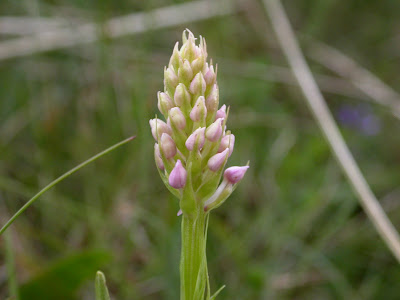
Whilst on the Ross of Mull I tried to get a photograph of the only known Pyramidal Orchid on Mull. What I thought was this plant (see 14th June) has now opened and it turns out, after having had it checked by the leading orchid expert of Britain, that it is an even better find. At first I was disappointed that it was just a Fragrant Orchid but the late date had me suspicious. Fragrant Orchid has recently been split into three species, Common Fragrant Orchid Gymnadenia conopsea which is rare in Scotland, Heath Fragrant Orchid Gymnadenia borealis which is the common fragrant orchid of Scotland and Marsh Fragrant Orchid Gymnadenia densiflora. The one I found on a sand dune is Marsh Fragrant Orchid which may be the first for Mull and is certainly rare in Scotland.

Also on the Ross, I found my first Perennial Sow-thistle. It has been recorded by others at Reudle.
This is the flower bud

and this is the leaf.

Sneezewort and Grass-of Parnassus were flowering on the Ross.
On the 27th there were 2 Yellowhammers on the electric wires near the turn off to Reudle village. Conversations with the owners of Reudle revealed that they have had Redstart around there house with a female on 13th August 2006 (Dave Thrussell pers. com.). This is a new species for our 10x10 square although it is not within the new Atlas years.
There was 1 Wheatear at Ensay and 1 Whitethroat and 1 Common Darter at Treshnish Old Schoolhouse.
On the 26th I found out that a moth caught on the 5th of June 2010 was a 'new' moth for Treshnish. This one was particularly fresh and purplish and so unmistakable, the Campion, so called because the caterpillar feeds here on Sea and Red Campion.

This looked so similar to another that I caught on June 1st 2008 that I re-checked it and found out that yes it was also a Campion (Lychnis is more common here and very similar).

On the 24th Leena heard the Corncrake at Haunn during the day, in the meadow below the cottages. The Swallow nest beside Middle cottage, Haunn has been rebuilt and now has eggs.
A fairly still, drizzly night seemed good for moths so I out the trap out. Although there were large numbers of some species (73 True Lover's Knot, 55 Triple-spotted Clay), there were only 31 macro-moth species in total. The best was a Six-striped Rustic

which I have only trapped 4 times before (1 in 2007, 2 in 2008 and 1 in 2009) all between 21st July - 3 August.
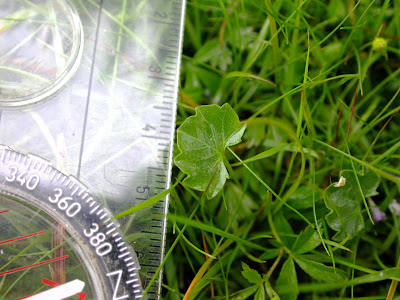
I found out from the vice-county recorder that the leaf I found at Reudle on the 19th was the base leaf of Harebell!
On the 23rd the House Martin nest was still not closed at the front (I presume the side is closed but it is hard to see). At least 1 House Martin is still around so I presume that they have eggs by now.
A Sparrowhawk flew over Treshnish wood with a prey item.
A Wormwood Pug came to a lighted window at Treshnish Old Schoolhouse, I have only caught this species in 2007 (1 on 3 nights).


The Field Gentian flowers at Haunn are now open (Stephen Harwood).
On the 22nd a Golden Eagle was seen diving towards Treshnish wood. I walked across the burn to see if it was perched and sure enough it was in the conifers, hopefully hunting rabbits.
The ungrazed grass at Treshnish House and Treshnish Old Schoolhouse provided good seed for a female Lesser Redpoll and adults feeding newly fledged Siskins which gave close views. A male House Sparrows was feeding newly fledged young which was making begging wing fluttering at Treshnish House. A Spotted Flycatcher was by Ensay Burn cattle-grid.
The front entrance of the House Martin nest is still open and I don't know if they are waiting until she lays eggs or whether they are going to leave it open. I suspect they will close it as they were away most of the day but when they returned in the evening they looked like they were adding a little to the front hole.
There were 2 Speckled Wood, 1 Common Blue and 2 possible Scotch Argus butterflies by the farm road beside Treshnish wood.
It was a good dragonfly day beside Treshnish wood with my first definite Common Hawker of the year (2+). This is a male

and there was also a teneral (newly emerged) which had much duller colours.
There were also 3+ Golden-ringed Dragonfly and a Common Darter.
On the 21st there was a Golden Eagle over Treshnish wood. No Corncrake was heard below Treshnish at 11pm at night and so both have apparently stopped singing although if they have bred successfully the females are probably sitting on their second brood.
On the 20th there was a female Mallard with 2 ducklings at Treshnish lochan and a male Bullfinch on the Tobermory Lighthouse walk.
There was a Red Deer fawn with its mother at Glac Gugairidh and I saw another within the last week elsewhere on the farm environs.
There was a probable Common Hawker dragonfly on the farm road beside Treshnish wood, a Four-spotted Chaser dragonfly at Reudle Schoolhouse bog and at least 2 Magpie moths at dusk nearby.
I went there to try to photograph Broad-leaved Helleborine. The plants in the wood were not noticeably further on than last week but I did find a plant in the open that I must have missed last week. which had open lower florets.


There was a Wood Avens which was flowering and fruiting at the same time, which helps me learn the fruit identification.


On the 19th there was a Spotted Flycatcher fledgling on the farm-road near the Ensay Burn cattle-grid. There was a Sparrowhawk above the Swallows at Treshnish House.
There were 2 Golden-ringed Dragonfly near summit of Ensay-Burg road (NM3746) and a possible Common Hawker by Treshnish Old Schoolhouse.
I went to Reudle village, which looked like a good track for Moonwort, a rare fern for Mull. I didn't find it but I found a leaf which I later found to be the lower leaf of a Harebell.
On the 18th in the morning the House Martin nest is missing the last closure of the nest. Perhaps they have to go slower to wait for the previous layer to dry as the nest get higher and shape gets more complicated.
There were 2 Speckled Wood, 2 probable Scotch Argus (if confirmed the first of the year), 4 Small Heath and 9 Green-veined White near Treshnish Old Schoolhouse. The latter two have been scarce lately and my graphs of their occurrence over 4 years shows they are probably double-brooded.
These are the graphs of the flight period of Green-veined White at Treshnish

and these are for Small Heath.

Speckled Wood looks like it is triple-brooded which fits with the literature.

I found this article about the Large Blue butterfly, one of the most fascinating conservation stories.
Rosebay Willowherb was seen flowering beside Treshnish wood but some has been chewed by a deer so it would probably have flowered earlier.
On the 17th a Golden Eagle flew from Cruachan Treshnish to Beinn Duill and there were Twite feeding on grass seed outside West and Toechtamor cottages, Haunn. The House Martins were on the nest in the morning and although they did no work on it in the day they added about an inch to the nest in the evening.
There was a male Hen Harrier in Haunn field and a Garden Tiger moth behind Toechtamhor cottage, Haunn (Julia & Stephen Harwood).
Only 16 moth species came to the light-trap but it was really too windy. The best was Light Arches. It is a nationally common moth but I only caught 6 over 3 nights in 2007, none in 2008 and 1 in 2009 and all were in a small window between 14th July and 7 of August.

Marsh Cudweed is flowering by Treshnish House. The Field Gentians at Haunn are still in bud but the petal colour is showing so they will be out very soon. They can be enjoyed from the farm-road near Toechtamhor cottage.
On the 16th there was a male Hen Harrier between Treshnish and Haunn cottages (Stephen and Julia Harwood). The Treshnish House Martins have been having a day off from nest building although in mid-afternoon just as I was about to add some extra support for the nest they arrived with mud. I continued adding some support for the nest and they only returned later to roost when it was raining.
Murray Loudon took some photos of the nest building earlier in the week.

You can see more photos of Murray's House Martins and Swallows from Treshnish here.
There is a Pied Wagtail nest with young near the dog kennels at Treshnish House but I have not had the patience to find the nest. There were at least 4 Swallows roosting in the Treshnish wood nissen-hut at sunset.
On the 15th there were 2 Golden Eagles on Cruachan Treshnish and a Sparrowhawk made a kill of what was probably a Swallow at Middle cottage, Haunn. The Swallow nest which collapsed in the shed beside Middle cottage has been rebuilt but no eggs have been laid yet and the House Martin nest at Treshnish is almost a completed as far as the structure goes. Lesser Redpolls were heard as usual over Treshnish wood.
Apparently the Haunn Corncrake has not been heard since Leena heard it during the day on the 10th, I went to Haunn at 11pm and did not hear anything but the Treshnish Corncrake was still calling. The Treshnish bird has been calling for 2 months and the Haunn bird was calling for almost 2 months. This may mean the Haunn bird has mated successfully and perhaps the Treshnish bird is still calling because he did not find a mate.
Guests at Shian saw 2 owls outside the cottage (presumably Tawny Owl).
On the 14th the Treshnish House Martins was again taking it easy. My theory is that the first frantic day of building is a bonding and mating ritual to communicate to each other that they are making another breeding attempt and this is the spot. After that they presumably have time before she is ready to relay. The literature states that the average nest building time, for a new nest, is 10 days.
On the Ross of Mull I found this which I initially thought was a Cinnabar Moth caterpillar. It was wishful thinking as there is so much Ragwort there. It is in fact an early stage (instar) of Fox Moth..

Talk about synchronicity. This is another early instar found on the Ross last year on exactly the same day, 14th of July.

In the evening I went to the Ross of Mull to look for the only known Pyramidal Orchid on Mull. Last year I failed to find it as it was eaten [by a slug?] within a week of being found. Today I though I found it but it is a little late this year and was not yet flowering. [Later found to be Marsh Fragrant-orchid].
Grass-of- Parnassus and Common Knapweed were flowering at Ardalanish beach
On the 13th the Treshnish House Martins must have worked the nest very little if at all but at least one of them was roosting in the nest at dusk. I read up about them and this is the usual behaviour and the young can roost in the nest long after fledging. The nissen-hut Swallows were also roosting in the hut at dusk.
During the day I very naively was admiring the number of swallows above the vegetable garden thinking how great it was that there were so many when I saw a Sparrowhawk apparently trapped between the chicken wire and the rose hedge. It was one of those 'wish I had a camera' moments, which was gone in a second as it became clear that the Sparrowhawk was not trapped but just trying to fly through the mesh. It immediately figured out that it just had to go backwards and so then it was free. So that was what all the Swallow activity was about, not "feed me mum and dad" but "'ware hawk".
There was a male Hen Harrier near the road at the Mishnish end of Loch Frisa.
On a walk the Tobermory Lighthouse there were newly fledged parties of Bullfinch (6+ at NM5156), Song Thrush (NM5155) and Blackbird (NM5155) and distant views of a White-tailed Eagle and a Peregrine and later over Tobermory main street a Peregrine flying with a kill! There was also a Speckled Wood (NM5155) and 2 Graylings (NM5156) there.
The Tobermory Lighthouse walk is an excellent place for a rare orchid on Mull, the Broad-leaved Helleborine. The flowers were not yet open but by the end of the month (perhaps within a week) they should be quite a site. This orchid is extremely rare on Mull with only one other site that I know of although it is not rare in England. This site is mentioned in Orchids of Britain and Ireland, A field and site Guide by Anne and Simon Harrap but I have been asked by the county recorder to mention to please stay on the path as it is very easy to trample on seedlings and other rare plants. I didn't have much time for looking at other plants as I was monitoring the orchids but I did find Skullcap flowering on the shore near Tobermory.
On the 12th in the morning the Treshnish House Martins were busy rebuilding their nest in the same spot . If they get far enough on I may try to reinforce it. By 7pm the nest was one third built.
A male Bullfinch was by the French 'No Hunting' sign beside Treshnish wood. This is only my second summer record in 5 years. The newly fledged Spotted Flycatchers were still being fed by their parents on the wire fence beside Ensay Burn cattle-grid. At 11pm the Treshnish Corncrake was calling.

On Carn Mòr Snipe were heard calling, which have been quiet recently and a Golden Plover was heard.
There was a Speckled Wood butterfly by Treshnish Old Schoolhouse.
There was a Large Heath on Carn Mòr at 9pm

and another earlier at Cruchan Odhor

and at 10pm a Dark Green Fritillary allowed a close up to the west of Carn Mòr.

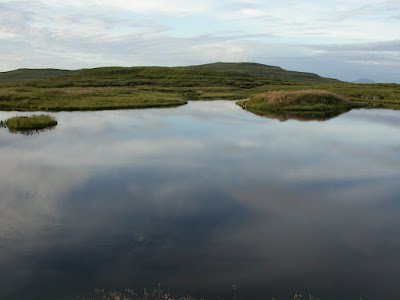
A view from a lochan on Carn Mòr showing Caliach with Coll and South Uist behind.

A view of Beinn an Lochain does not capture the magic of this place.
Cross-leaved Heath was flowering on Cruchan Odhar and Ling was flowering on Carn Mòr.
On the 11th the Treshnish House Martin nest was found collapsed. There were no signs of eggs or young so presumably they have been eaten by a predator. At 8pm the pair were attempting to rebuild the nest. I always had concerns about the nest as it had two cracks from where they had apparently changed the type of mud they were using so the nest was built in 3 layers with cracks between the layers.
At night (1am) the Treshnish Corncrake was calling from below Duill cottage. The wind was not strong but still it could not be heard without walking a hundred north of the cottages. Obviously when it can he heard from the farm-road between the cottages and Treshnish wood it must be calling from a little further to the east.
A pair of Tawny Owls was heard duetting by Treshnish Old Schoolhouse. All 6 of the family of Swallows were roosting in the nissen-hut by Treshnish Old Schoolhouse and a night-time visit to the House Martin nest looked as though the small lip of remaining mud had either been removed or had fallen off.
On the 10th the Treshnish Corncrake was calling at 8.30pm and Leena heard the Haunn male calling during the day. The Reed Bunting was calling again in Black Park field, just before the gate leading into Haunn field. The Swallow nest in the shed beside Middle cottage was on the floor with at least 4 dead chicks. This could be predation by the black feral cat. On a more pleasing note, the Treshnish House Martin chicks may have hatched today; the adults were noticeably excited. The 4 nissen-hut Swallow fledglings were all flying around outside with their parents.
The Loudons, guests at Duill cottage pointed out to me a dead immature Adder, which had been ran over on the farm-road to Haunn. Fenella from Shian cottage saw an Otter at Langamull.
The Field Gentians are a few days away from flowering at Toechtamhor cottage, Haunn.
On the 9th the Treshnish Corncrake was calling at 11pm. A Reed Bunting was calling in Black Park field, just before the gate leading into Haunn field. There was at least 1 Twite at Treshnish House and 2 Wood Pigeons at Ensay farmhouse which we haven't seen recently. The 4 Swallow fledglings were back in the nissen-hut in the morning, so they are using it for protection. There are so many Swallows in the farm buildings proper that was difficult to see if the young were returning there for shelter but obviously they do.
A brief visit to Calgary beach machair was a pleasant surprise. I had visited a fortnight ago and thought I was imagining how less grazed it was. But no, it really is looking good. A couple more years like this and it will equal Ardalanish! I didn't find any Frog Orchids though and it looks like they may have been lost from this site but with continuing low grazing they should return. The sandy shore was covered in clumps of flowering Sea Rocket. Locals think this could be a result of the mild winter 9storm-wise) but low grazing is sure to have had some effect too.
At night the moth-light attracted only 22 species but it was a bit cold. None were exceptional although Garden Tiger and Drinker are always nice to see.
On the 8th there was a Collared Dove around Treshnish House and family group of Siskins, including fledged young, below Treshnish House.
These Swallow chicks are still in their nest in the vegetable garden.

Two of the Swallow fledglings left the nissen-hut this evening although these two were not quite ready.

The Treshnish Corncrake was calling just before midnight.
There were 4 Sand Martins on Treshnish farm (Geoff Carr et al.)
A Speckled Wood was obliging in Treshnish wood even with the dogs galloping around.

and there were at least 2 Graylings butterflies at Ensay Burn mouth and 3 below Treshnish House.
Phacelia was found flowering in Treshnish vegetable garden. I shall have to ask Carolyne if this is an escape from her flower garden if not it must have come in with some outside material. Northern Dead-nettle has been flowering there for some time.
On the 7th there were recently fledged Spotted Flycatchers beside the Ensay-Treshnish bridge and more on Ensay to the north. Swallow fledglings have left the nest in the nissen-hut beside Treshnish Old Schoolhouse.

There were 4 or 5 Grayling butterflies on the Ensay side of Treshnish wood (NM3548).
Today I identified a leaf I found on the 29th of June. It is a plant which others have reported at Treshnish but which I hadn't been able to find. No wonder, it was on the edge of a small cliff on the Ensay side of the burn. The shrub is the Guelder-rose.

It had only one flower umbel left today.


The Common Twayblade plants in Treshnish wood are looking great this year.

At another site I managed to re-locate a Broad-leaved Helleborine plant which was flowering in 2007. This year it was not flowering.

Tutsan was flowering in Treshnish wood.
I found a few more Hazel Gloves fungi along Ensay Burn in Treshnish wood but these 2 were perfectly healthy and also on a Hazel I must have passed hundreds of times!


On the 6th a Grasshopper Warbler was heard near Haunn cottages (Christoph Harwood).
On the 5th there were 2 Linnets by Haunn cottages.
On the 4th a Corncrake was seen right outside Toechtamhor cottage and there was a Hen Harrier between Treshnish and Haunn cottages (Harwood family). I also received some photos taken by Steve Fryday whilst staying at Toechtamhor cottage. You can see them in the slide-show on the right.
There was a Speckled Wood butterfly near Treshnish Old Schoolhouse.
On the 3rd a Grasshopper Warbler was heard just below Haunn cottages. The Haunn Corncrake was calling occasionally during the afternoon and more often in the evening but the Wards said that last night it had starting calling again loudly, they also said that before it went silent it was calling a lot during the day. This is almost classic post breeding behaviour so maybe they ARE having a second brood.
The Swallow chicks are sticking their heads above the nests on East cottage and the shed beside Middle cottage and Pied Wagtails have a nest with chicks in a hole in the bank beside the container at the cow-barn.
Malcolm Ward a guest at East cottage between 26 June- 3rd July included these records:
male Linnet at back of East
Stonechat
Starling flocks go over Haunn between 9.30-10pm daily
2 pairs of Kestrels between Haunn and Crackaig
Lots of Meadow Brown butterflies from 30th onwards
Speckled Wood butterfly in Calgary wood and Ulva
Red Admiral butterfly near Calgary cemetery
Painted Lady butterfly at Ulva (south shore)
Six-spot Burnet moth on Headland above Port Haunn and at Ulva

Corncrake
present from 26th to 30th but stopped calling around 21.00 of 30th until 19.00 2 July when heard calling outside door of East cottage
.
He has a recording of night time calling.

On the 2nd I heard from Malcolm Ward, staying at East cottage, that the Haunn Corncrake had been very quiet for the last couple of nights. I am hoping that this is the quiet period after mating and before egg-laying which could mean a second brood. This may not be too optimistic as two Corncrakes were seen here on the 2nd of June. If they mated after the male had been calling for a couple of weeks I calculate that the young would be independent (but still not able to fly) by about the 1st of of July and the female would be ready to mate soon after.
If the female laid eggs immediately after being seen with the male on the 2nd of June, the young could be independent at the earliest, on the 30 June and the female would relay on average 12 days later, which would be on the 11th of July. (Reference: Birds of The Western Paleartcic - DVD updates).
On the 1st guests at the Sheiling, saw a Corncrake at Haunn. Today we received a video clip of the Haunn Corncrake taken by Lesley Few! If you missed seeing it here it is. There was a Collared Dove in Treshnish garden and a male Reed Bunting was singing by the road just before where the Black Park field enters Haunn field. Curlews were still holding territory above the cow-barn. It was nice to hear the Treshnish wood Tawny Owl at sunset.
A Common Gull at Ballgown obviously had a nest near the shore and a Pheasant had 3 fledglings.
Malcolm Ward left these records:
A Great Skua near Port Haunn, very close in attacking a Gannet
Treshnish Corncrake heard in bottom field
At 19.48 2 miles west of Port Haunn a breaching Basking Shark (breached once).

Not wishing to publicise this rag but they have the best photo of this breaching Basking Shark here.
Greater Bird's-foot Trefoil was flowering along farm-track beside Treshnish wood.
At Ballygown I surveyed part of a tetrad for our plant vice-county recorder. I found Scots Lovage flowering,

Purple-loosestrife,

which I was surprised to find close to the shore,

Common Centaury,

Nipplewort,

Wood Avens fruiting,

and Upright Hedge-parsley (non flowering), lots of Skullcap, 1 Gypsywort (not flowering yet) and Wilson's Filmy-fern.
I also found a new site for Hazel Gloves fungus.

The fungus was healthy but the hazel itself is not regenerating.
You can see that this stroma was growing on two branches which were stuck together but has broken apart probably by the wind.

The branches are stuck together by glue fungus which the Hazel Gloves is associated with.

April 2010

On the 30th there was a female Hawfinch
in Treshnish House garden!  Not only is this species scarce in Britain it is very rare on Mull. The only previous record for Mull was one on a bird-table at Frachadil, Calgary last year on the 15th of June. There was also a female at at a bird feeder on Colonsay on the 8th and 9th of April this year, which had a bar on the scapulars (the upper white bar on the wing) as did the Treshnish bird and I presume they are the same individual.
In 2007 there had only been 14 records in Argyll since 1953 (Argyll Bird Report 2006-2007)!
There were also 5 Twite in front of The Studio (1 or 2 singing vociferously), 1 Linnet at Treshnish House and Lesser Redpoll flying over. I heard a possible Green Woodpecker below Treshnish wood but I am a bit rusty with this call, obvious though it is. There were 2 Red-throated Divers off Ensay Burn mouth, 1 Cormorant on the rocks there and 2 male Cuckoos squabbling over Treshnish wood with some Meadow Pipits nearby when they landed. The Meadow Pipits did not seem alarmed. Is it possible that pipits that have reared young fail to regard them as a threat but sympathetically as offspring? I am sure if this is true it will have been written about somewhere. An alarmed Wren along the edge of Treshnish wood presumably had a nest nearby. Again a Mallard was seen twice flying to Treshnish lochan and there were at least 3 Sand Martins above Treshnish wood. SC saw about 12 Golden Plovers a few days ago (about the 26th) at the same place he saw them on about the 15th of April on Beinn Duill near the upper cairn above Port Haunn. A Tawny Owl was heard by Treshnish Old Schoolhouse, it has been incredibly quiet this year.
There were 2 Emperor Moths
 
in the trap last night. One was so colourful I thought it might have been a male but the hindwing was not orange enough.

A large dark butterfly by Treshnish Old Schoolhouse was presumably a Peacock.
On the 29th a Common Whitethroat was near Treshnish boathouse (first of the year and 2 days earlier than our earliest date) and a Wood Pigeon was in Treshnish wood. At Mishnish Lochs (Loch Peallach) there were a pair of Goldeneye (the latest date I have is 2 males at Mishnish on 9th May 2006.). There were a pair of Mistle Thrushes between Frachadil and Langamull forest with another at Achnadrish (before Loch an Torr). A Greater Spotted Woodpecker was drumming at Calgary castle wood where it was also seen and heard on the 26th. There was a probable Peacock butterfly at Treshnish Old Schoolhouse and 1 (same?) at Treshnish House. Another Hazel Gloves fungus was found in Treshnish wood. A patch of Slender Speedwell Veronica filiformis was flowering beautifully at Treshnish House. This is rare on Mull. It has been flowering for a couple of days and should be in flower for another 2 months.
On the 28th the Blackbird eggs (in the nest photo on 21st) have hatched and a Sand Martin was over Treshnish wood. One Common Twayblade in Treshnish wood is in leaf with a flower shoot emerging and lots of new Hazel Gloves fungus was found in Treshnish wood most of it not slug-grazed which is exceptional since elsewhere I have only found one or two healthy stroma and the rest have been slug-grazed.
On the 26th there were 2 Whimbrels on Calgary beach (my first of the year) and in the early morning 2 Greylag Geese there. At Loch Frisa there were 2 pairs of Red-throated Divers; when one pair started calling and displaying then all 4 would start stretching their necks and calling loudly, fantastic! There were it seems, several Cuckoos at Loch Frisa or else a very mobile one because their call was heard often and over a large area. There were also several Tree Pipits at Loch Frisa (the first of the year for me but obviously they had been there for a few days). This is a very good site for this species. There were two pairs of Red-breasted Mergansers, a pair of Greylag Geese and a pair of Common Sandpipers at the fish-farm. In the middle of the Loch there were 3 Cormorants and at least 1 Greylag Goose. Finally managed to catch up with the two European Bee-eaters, late in the evening, at Calgary (not great views so if weather permitting I will try again tomorrow). An adult (possibly sub-adult) White-tailed Eagle flew from Frachadil towards Caliach Point, it had wing tags but I didn't get a good view (they were possibly white). As I type a Mountain Hare trots into our garden! At night there was a very poor catch in the moth-trap. It seemed like a good night, foggy with only a light breeze. The moon was full which is not helpful but it only occasionally broke through the cloud. Yet only 5 moths in total (4 species)!
A bit about bee-eaters: I will refer to the international name European Bee-eater for the species at Calgary since with rarities other bee-eaters could occur. [I have so far failed to find the Blue-cheeked Bee-eater in India and the closest I have come to it is in Denmark where it is extremely rare, it may even have even been a first for Denmark, anyway I tried to twitch it but 'dipped' (missed it). I did see a European Bee-eater though, close to where we lived in western Jutland.] I was looking in the new Birds of Scotland and was surprised to find out that the Calgary birds are the earliest records yet for Scotland. The earliest previous date was on 2nd of May 1966. It has never bred in Scotland but did attempt to breed in Lothian in 1920 but with global warming and a pair breeding in Durham in 2002 anything is possible. When we were living in Denmark breeding had started there too, so their range is definitely spreading northwards. Most records in Scotland come from Orkney and Shetland and elsewhere there are only 19 post-1980 records and of these Argyll has 5, of which 3 were on Mull: at Lochdon area (1993), Fidden (1995) and Glengorm (1998). There has only been one post 1980 mainland record on Argyll, the only other records being on Islay (twice).
Whilst a Calgary I had a conversation with an elderly man working in a garden, who told me that he has seen a Cough at Calgary 4 or 5 years ago. The last breeding on Mull was in 1992. The Argyll Bird Report for 1992 mentions 'one pr on Mull bred unsuccessfully for the 4th successive year'. Alan Spellman in the Isle of Mull Bird Report (2009) mentions 3 birds attempting to breed at Scoor on the Ross of Mull 'for some years, but have not been seen in their usual area for about 5 years'. This must have been at least 8 years ago. I checked back to his 2004 Report and there Alan wrote 'Three birds were at Scoor attempting breeding for some years but have not been seen in their usual area this year 2003'.
The same gardener also told me that about 10 years ago he saw a Little Owl at West Ardhu, near Dervaig. The problem is that Little Owl has never occurred in Argyll before. The nearest regions are Clyde and Ayreshire and the nearest confirmed breeding is close to the border. Of course this does not rule out the possibility of a Mull record but without further conversation to find out how long it was present it does not rule out the possibility of another nationally much rarer small owl, Eurasian Scops Owl, which has occurred in Argyll (once on Tiree in 1997) or even the extremely rare (and also extremely unlikely) Tengmalm's Owl.
Further conversations whilst waiting for the bee-eaters to re-appear mentioned records of Water Rail, Goldeneye and Coot at the hotel pond. I have the Coot on the North Mull Bird list and a Goldeneye at 'Calgary' (which I had presumed was in the bay) but not the Water Rail. Must find out more.
On the 25th there were at least 2 Fulmars around the cliffs at Treshnish Point. I wasn't in a position to see the nest ledges. I saw 5 or 6 Curlews or Whimbrels flying around Treshnish Point but too far away to identify. I heard my first Cuckoo at Treshnish House and Haunn today although others heard it several days ago. There was a Wood Pigeon above Treshnish wood. There have been a pair of Bee-eaters in Calgary for 2 days.
On the 24th there were a pair of Wood Pigeon flying west from Treshnish wood and a Mallard flying from Treshnish lochan north to the coast.
On the 23rd there were again a pair of Mallard flying from Treshnish lochan north to the coast and first Bluebell was flowering in Treshnish wood.
On the 22nd there were at least 2 Swallows around the building and obviously not just passing through. A superb male Hen Harrier flew along the farm-road in front of Treshnish Old Schoolhouse! There was a Dipper again at the same spot by the waterfall below the second stone bridge between Ensay and Reudle Schoolhouse. Great news maybe they will breed and I can get a good photo! Better than this one on the 19th. The white dot at the very top left of the waterfall is the Dipper's breast!
There was a Red Deer stag on Beinne Reudle, which apparently move higher up the hills in summer.
Red Dead-nettle , Springbeauty and Thyme-leaved Speedwell were flowering in Treshnish garden. The latter was in The Studio plant tub, the leaf size was up to 2cm and one book I have gives the leaf size as up to 1.5cm but I can't think what else it could be.
On the 21st a female Blackbird was accidentally flushed off her nest at the edge of Treshnish wood.

Nearby a Tawny Owl was also flushed whilst I was pishing a Willow Warbler to come closer for a photo. I think I have only ever seen a Tawny Owl during the daytime once before here. They are very quiet at night, much quieter than one would have thought if they are breeding. Also in Treshnish wood there were 4 Wood Pigeons, a singing Goldcrest, a pair of Treecreepers and flying above, 1 Swallow. There were about 250 Kittiwakes between Rubha nan Oirean and Caliach Point, a pair of Mallard flying from Treshnish lochan and 2 Lesser Redpolls at Treshnish boathouse (first of the year). At Ensay Burn mouth there were 2 Greylag Geese, 1 Redshank, 1 Common Sandpiper (first of the year), 1 Swallow and offshore 1 Great Northern Diver. A Golden Plover was heard at Haunn and the other day SC saw about 10 near the cairn above the cliffs near Port Haunn.
There was 1 Mountain Hare by Treshnish graveyard and 1 above Treshnish boathouse.
There was 1 probable Green-veined White butterfly and 1 Peacock butterfly by Treshnish Old Schoolhouse as well as 1 Drinker moth caterpillar.
On the 20th 2 Greylag Geese flew from Treshnish direction to Calgary beach where there was a summer plumaged Great Northern Diver. A pair of Buzzards were over Treshnish wood, with one of them giving a great sky-diving display. There were also 2 Wood Pigeons in Treshnish wood and a Hooded Crows nest near the Ensay Burn cattle-grid. After only about 30 seconds of casting a view from telescope out to sea a Great Skua was picked up flying north across Calgary Bay. At Lainne Sgeir, Calgary there were a pair of Shelduck (a little later also seen at the beach) and an Otter.
Marsh Marigold was flowering near Calgary beach and another Hazel Gloves fungus was found at Lainne Sgeir. Most of us know what the male Hazel catkin look like. Here is the female flower.

On the 19th 2 Greylag Geese flew from below Treshnish wood towards the fields below Treshnish House. There was a Dipper above the waterfall just below the second stone bridge from Ensay to Burg. I didn't see it there at all last year but the previous year it attempted to breed (proof of breeding not found yet). A Raven was making a call to its mate. I am not sure I have noticed before (or do I forget each year), it sounded like a slow moving football rattle. Hooded Crows also make unusual calls at this time of year. The Buzzard nest along Ensay Burn (above the wood) which had chicks in 2008 is unoccupied. I thought at least Ravens may be using it but good site that it is, there must be better elsewhere (unless it is still to early). There were a pair of Mallard by Ensay Burn cattle-grid. More Hazel Gloves fungus was found on Ensay above Treshnish wood.
On the 18th there were about 200 Kittiwakes feeding off Caliach Point there were 8 Wood Pigeons in the wood between the boathouse and the cow-barn. Sexual shoots of Field Horsetail were near Ensay Burn cattle-grid.It took only about 5 minutes to find 2 trees with part slug-grazed Hazel Gloves fungus on the Ensay side of the cattle-grid (one stroma -the 'glove'-had parts of a several 'fingers' still intact), one of the trees had 5 stroma and the other had 1. Then I explored from the wood below the cow-barn downwards and found 28 stroma on 10 trees near the wee burn. One was almost intact and perhaps was just old not slug-grazed.
This is obviously an extremely good area for this fungus. Here is where it has been found in north-west Mull.
Another fungus was found near Ensay Burn cattle-grid. I have seen it elsewhere on dead wood. I think it is Trametes versicolor (Turkey-tail Fungus).


On the 17th there were 10 Golden Plovers circling and landing in Skoma field, Haunn, a drumming Snipe above Middle cottage, Haunn and a loose flock of about 100 Meadow Pipits by Toechtamhor cottage, Haunn. Most of the time birdwatching raises more questions than answers. Are these Meadow Pipits the resident birds or are they migrants. If they are resident do they form these flocks just for foraging because at other times there are individuals singing. The same goes goes for the 10 Golden Plovers seen today, wouldn't our resident birds be paired up on the hills? Perhaps it is still too early. Was the Golden Eagle taking a lamb skin to the eyrie the other day for chicks? (This question at least would be easy to answer if I had a licence to approach the nest). Why has this pair failed for so many years? Where do the Grey Herons which we see here breed? (The nearest heronry I know of is at Quinish but ours always seem to come from the south). What is the immature Common Gull doing in the breeding colony? (This one I may be able to answer but I feel very unwelcome intruding on these gulls and have only once attempted to explore during the breeding season and they are so secretive it was very hard to see anything. Only later have I been able to see chicks just prior to fledging when they are too big to hide. The pre-breeding flock of about 40 which was congregating at the shore below Treshnish House had 2 immature birds. Is that some indication of the mortality rate, 20 pairs succeeding in rearing 2 birds through the winter? And on........
There was a Mountain Hare
 
in our garden at Treshnish Old schoolhouse in the morning and at dusk. When crouched down it is very rabbit-like but the same hare standing looks very much Hare.

(Excuse the bad photo taken through a slanted window). Leena thought she saw a Rabbit in the same spot yesterday morning but it was probably this loon/quine.
On the 16th there were 1 or 2 Lapwings at Treshnish House.
On the 15th there were 2 White-tailed Eagles on hill to south of Frachadil, Calgary, 1 Sparrowhawk and a pair of Shelduck at Lainne Sgeir, Calgary and a little closer to Calgary beach 1 summer plumaged Great Northern Diver. There were a pair of Bullfinches at Penmore Mill and a Mistle Thrush at Croig. I went to Croig and later Penmore, looking for Orange Underwing, a day-flying moth which can be found flying above birch trees before the leaves emerge. They can be seen at Scallastle forest walk just to the north of Craignure but I was hoping to find them more locally. Perhaps it was too cold and not sunny enough, as I had no luck.
On the 14th there were 3 Great Northern Divers off Ensay Burn mouth and a pair of Mallards flying there from Treshnish lochan. Highlight of the day was at least 20 Bottle-nosed Dolphins fishing as they moved north across Calgary Bay moth towards Caliach Point. Another equally impressive event occurred later when I was alerted by the gulls to a Buzzard on a freshly killed Rabbit beside Ensay farmhouse. The Buzzard fed on the rabbit for about half an hour or more and then moved with a combination of walking/hopping (dragging the rabbit from one talon) and very short flights to a more exposed spot and then started making a call sharp short 'kuu' call repeated a few times and after a pause again repeated. The later calls were followed by the beginning of a more normal buzzard call. I was sure it was calling to its mate and sure enough another buzzard answered. After further 'soliciting' type calls along with a slightly mantled display which including a brief wing shivering behaviour whilst continuing the slight mantling of the food. The second Buzzard approached but the fist bird continued to feed for a few minutes more before the second bird approached more closely and was allowed to drag off the rabbit. The second Buzzard now had full possession but it had to drag and make a number of short flight before it was ready to eat only about 100m from the change-over place.
A presumed Small Tortoiseshell was on the farm-track above Treshnish wood. Another slug-grazed Hazel Gloves fungus was found just below the cattle-grid between Treshnish House and Treshnish Old Schoolhouse. Cherry and Lungwort (an introduced plant) is flowering in Treshnish wood.
On the 13th there were 1 or 2 Lapwings 'mobbing' a Buzzard above Ensay farmhouse so obviously they are breeding up there again. The first Sand Martins (9) were seen above Treshnish wood (exactly the same date as our previous earliest date). There have probably been Sand Martins at Calgary beach for a few days, as elsewhere they have been seen at their colonies in the last few days. Also at the wood were 1 Swallow, 1 Sparrowhawk, 2 Wood Pigeons and a singing Goldcrest. A Cuckoo was heard at Reudle Schoolhouse (CM) and another or same at Haunn (LF), these were our first and 6 days before our previous earliest record. There was a Redshank and 2 Great Northern Divers at Ensay Burn mouth (1 in mostly winter plumage), another Great Northern Diver flying north across Calgary bay mouth, 2 Grey Herons over Treshnish boathouse and 1 Mallard from Treshnish lochan. A Snipe was drumming over Treshnish Old Schoolhouse at dusk (guests at Toechtamhor cottage informed me that they had heard one calling profusely). A Mountain Hares was disturbed from just 5 yards from its resting place in little 'bower' under some dead bracken by Treshnish graveyard. Another large butterfly flew passed Treshnish Old schoolhouse (Red Admiral or Peacock presumably). Common Scurvygrass, Thrift, Eared Willow, Blackthorn, Wood-sorrel and Wood Anemone were flowering at Treshnish boathouse where there were also several hazel trees with Hazel Gloves fungus (all slug-grazed). Dandelion was flowering beside Treshnish wood.
On the 12th a flock of at least 10 Collared Doves flew into Treshnish wood. Collared Doves are uncommon at Treshnish but I have seen the glimpse of a flock once before. Today I also heard for the first time part of the song of a Wood Pigeon in the wood; 2 Wood Pigeons were seen. There was a probable Green-veined White, at Treshnish (SC), which is 6 days before our previous earliest date, 1 Red Admiral by Treshnish Old Schoolhouse and infuriatingly poor views of at least 2 orange butterflies also by Treshnish Old Schoolhouse, which I can only presume were Small Tortoiseshell. There were another 5 Drinker moth caterpillars on the other side of Treshnish Old Schoolhouse from yesterday. I have never seen more than 6 in one place before so the total of 13 here is exceptional.
On the 11th there were at least 3 Willow Warblers (our first ) in Treshnish wood (this is exactly the same date as last year which was the earliest date at Treshnish although they had been seen in Calgary the previous day). A Great Northern Diver was off Ensay Burn mouth where there was also a Grey Wagtail. A Sparrowhawk was seen over Ensay farmhouse and 3 Linnets and 3 probable Siskins were in Treshnish wood. There was again a pair of Mallard and a pair of Curlews flying from Treshnish lochan (both are seen most days this week). A Tawny Owl was heard by Treshnish Old Schoolhouse (the first for several weeks-very odd). Two more sites were found for Hazel Gloves Hypocreopsis rhododendri along Ensay Burn near the burn mouth. Both sites had about 10 on single tree
and one site involved 2 Hazel trees but all were slug-grazed. This shows the uneaten 'fingers' at the bottom of the photo.
 
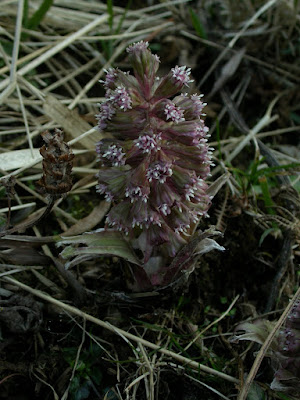
Butterbur was flowering

at Ensay Burn mouth (11 days after the earliest date) but it has probably been flowering here for a few days already. The Magnolia in Treshnish wood is flowering profusely and is attracting birds like in the orient. Chaffinches, tits and Willow Warblers were feeding on the [nectar] of the huge flowers. There were at least 8 Drinker moth caterpillars by Treshnish Old Schoolhouse and a butterfly was also seen flying there which was probably Small Tortoiseshell. There were also 2 Mountain Hares by Treshnish graveyard, 1 was punching the air for a moment in the 'boxing' movement.
On the 10th 1 adult and 1 other White-tailed Eagle flew from Treshnish Point to Treshnish boathouse. There were 3 Twite beside Haunn cottages, which were my first of the year but what was exciting was that one had coloured rings. Its right leg had a yellow ring below and metal ring above and its left leg had a white ring below and an orange ring above. We should be able to trace where it was ringed. It is not the same ringed bird that was at Toechtamhor cottage in May last year. There was also a juvenile Rook below the cow-barn, it had not yet attained the while bill base of the adult and at first I thought it was a Carrion Crow. Carrion Crow would be a real rarity on Mull but at Treshnish Rook is quite scarce. 2 Wood Pigeons flew over Treshnish wood and there was 1 Pied Wagtail and 1 Grey Wagtail in Treshnish Old Schoolhouse garden (the latter a first for our garden). A Common Dog Violet was flowering by Middle cottage, Haunn. This is much later than any previous earliest date.
On the 9th the our first Swallow of the year flew over Treshnish house. This is my earliest record here, the previous being on 11th of April 2007. A Golden Eagle was seen carrying a lamb skin (SC) and a Linnet flew over Treshnish wood.
On the 8th there was a Great Northern Diver in near full summer plumage off the 'pink pier' Calgary bay. There were 7 Wood Pigeons over Treshnish wood. At Penmore I found my first Tunbridge Filmy-fern Hymenophyllum tunbrigense.

This tiny fern was not found in North Mull by the Averis & Averis surveys of Mull where they had 1 record near Craignure and 7 in south Mull. The Mull Flora by Jermy and Crabbe only had one record for Mull (in the south-east). I am pretty sure of my identification because of the frilly spore-cases but the leaf shape is also totally different from Wilson's Filmy-fern (see below). I also found another Hazel Gloves Hypocreopsis rhododendri which was slug-grazed.

I also realise that a fungus I found on 5th of December 2008 in the Hazel woodland running down to the coast from just south of Reudle was this species.
On the 7th a White-tailed Eagle flew west below Treshnish wood, there were about 60 Kittiwakes off Caliach Point and 2 Mallards flew to Treshnish lochan, 1 Manx Shearwater (first of the year) flew north from off Treshnish Point and 7 Wood pigeons flew around Treshnish wood. There were 2 Peacock butterflies at Treshnish Old Schoolhouse. These are my first Peacocks of the year but not my earliest date. In 2007 SC saw 1 on 7th of March and I saw singles on 25th & 26th of March.
On the 6th 5 Greylag Geese flew south from Rubha nan Oirean to Treshnish boathouse, later 7 more flew from Rubha nan Oirean around Treshnish Point and 1 Great Skua flew north across the mouth of Calgary Bay. A new record for Hazel Gloves fungus Hypocreops rhododendri
was found by Ensay Burn. This fungus is extremely rare in Britain. It was first discovered in Europe on Mull as recently as 1975 (Scottish Natural Heritage) or 1973 (Natural England).
On the 5th there were about 90 Kittiwakes off Rubha nan Oirean, Calgary Bay, 1 Great Skua flew north across the mouth of Calgary Bay and 2 Mallard and 1 Black-headed Gull flew over Treshnish lochan. Black-headed Gull is scarce in north-west Mull, I haven't seen one here since October 2008.
On the 4th there were 2 White-tailed Eagles below Treshnish House (SC).
On the 3rd I went looking for the rare Hazel Gloves fungus Hypocreopsis rhododendri at Treshnish wood. I failed to find it but found Wilson's Filmy-fern Hymenophyllum wilsonii
be abundant in the old Hazel coppice there. This shows it's size and how it can be mistaken for a liverwort
On the 2nd there was a White-tailed Eagle seen to the east of Calgary (SC, CC & MC) and there was a Great Skua between Treshnish Point and the Treshnish Isles (first of the year and equal earliest with 2006). There was also a female Sparrowhawk or Goshawk over Treshnish Old Schoolhouse. It was large and longer winged, so much so that at first I thought it was maybe a Hen Harrier. The Argyll Bird Report 2006-2007 has just come out and it was interesting to see that our records for Manx Shearwater (2006), Great Skua (2006), Arctic Skua (2006) and Pomarine Skua (2006 at Quinish) were all first records for Argyll. My first Drinker moth caterpillar

of the year was on the logs outside Treshnish Old Schoolhouse. This is an overwintering caterpillar and the last one I saw was on the 30th of September.
On the 1st there was a Fieldfare on top of a conifer in Treshnish wood. New links have been added on the right side of this diary to photos from Treshnish of 'Mosses and Liverworts,' 'Lichen' and 'Micro-moths.' The micro-moths have been checked by an expert so any mistakes are through my editing. The Mosses, Liverworts & Lichens photos that have been checked have 'OK' at the beginning of their caption, those without are not trustworthy at all!